
Now Reading: Strategic Models for Global Capability Centers: From BOT to GCC 3.0
1
- 01
Strategic Models for Global Capability Centers: From BOT to GCC 3.0
Strategic Models for Global Capability Centers: From BOT to GCC 3.0
 ScaleGCC Editorial TeamGCC Strategy6 months ago786 Views
- Home
- GCC Strategy
- Strategic Models for Global Capability Centers: From BOT to GCC 3.0
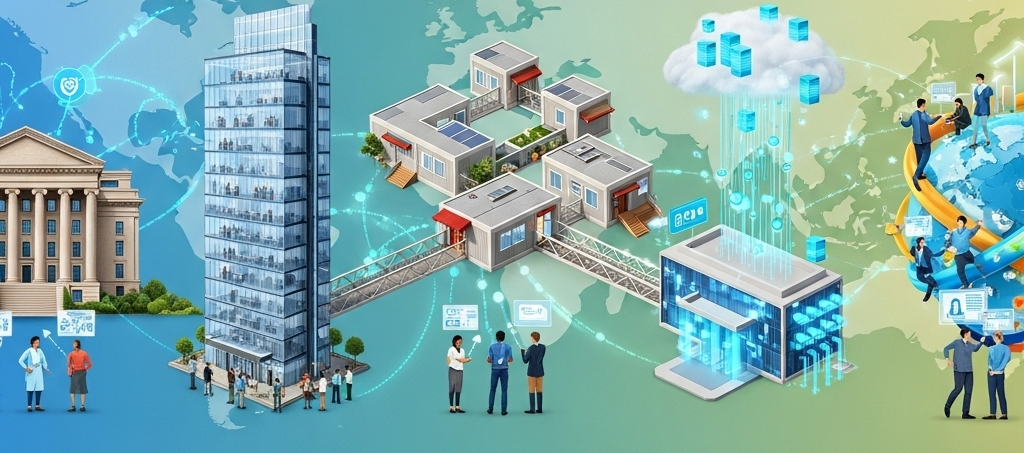
What if the future of your company’s innovation, cost savings, and global competitiveness depended on a single decision? That decision is choosing the right GCC operating model. The structure you select, whether COCO, COPO, BOT, or GCC 3.0, will shape how your Global Capability Center evolves: as a back-office cost unit or as a strategic nerve center driving enterprise transformation.
Strategic Models for Global Capability Centers
Global Capability Centers (GCCs) have become one of the most powerful enablers of global business transformation. Initially established as cost-saving offshore hubs, they have matured into strategic centers of excellence leading digital innovation, AI adoption, and leadership development. With over 1,900 GCCs in India alone and hundreds more worldwide, enterprises are increasingly realizing that the operating model defines the long-term value of their GCC investment.
Must Read: What is a Global Capability Center? Complete 2025 Guide
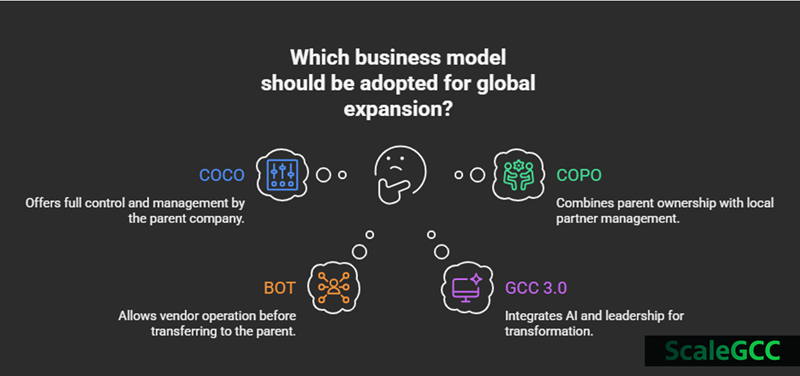
Quick Definitions at a Glance
COCO (Company-Owned, Company-Operated): Fully owned and managed by the parent enterprise.
COPO (Company-Owned, Partner-Operated): Owned by the parent, managed by a local partner.
BOT (Build-Operate-Transfer): Vendor builds, operates, then transfers GCC to the parent.
GCC 3.0: Next-gen model integrating AI, leadership, and transformation.
What Are GCC Operating Models?
GCC operating models outline the structure of ownership, control, and governance between a parent company and its offshore center. In the early years, most GCCs were purely about cost arbitrage, shifting work to low-cost geographies. Over time, they grew into digital and R&D hubs, and today, they are expected to be innovation engines that shape enterprise-wide strategies.
The chosen model impacts:
How much control the parent retains.
The balance between CAPEX and OPEX.
The speed to market in a new geography.
The center’s ability to deliver innovation and leadership value.
GCC Build-Operate-Scale Cost ROI Simulator
Try Our ToolGCC Operating Model Selector
Try Our ToolCOCO: Company-Owned, Company-Operated GCC
The COCO model places complete responsibility on the parent company. It establishes a legal entity, manages compliance, sets up infrastructure, and directly governs daily operations. Though resource-intensive, it provides the highest control, security, and cultural alignment.
Advantages:
Strong IP protection and compliance control.
High cultural and strategic alignment.
Better long-term cost efficiency.
Disadvantages:
High upfront investment.
Slower setup (12–24 months).
Requires local compliance expertise.
Example:
HSBC and JPMorgan both run COCO GCCs in India, securing regulatory compliance and cyber resilience.
COPO: Company-Owned, Partner-Operated GCC
In the COPO model, the parent company owns the GCC entity but outsources operational management to a partner. This speeds up setup while reducing the parent’s administrative burden. However, it also means less direct control.
Advantages:
Faster market entry.
Leverages partner’s local expertise.
Shared operational risks.
Disadvantages:
Reduced control over culture and governance.
Risk of partner misalignment.
Hidden long-term costs via service fees.
Example:
A Silicon Valley SaaS firm expanded into Poland under COPO, scaling operations in under six months by leveraging its partner’s HR and compliance networks.
BOT: Build-Operate-Transfer GCC
The BOT model is a phased strategy where a vendor builds and manages the GCC for a period, then transfers ownership to the parent. It minimizes upfront risk while allowing eventual control.
Advantages:
Fastest time to market.
Low upfront investment (OPEX-heavy).
Structured transition to parent control.
Disadvantages:
Transition risks during handover.
Vendor dependency in early years.
Possible cost creep from vendor fees.
Example:
Pfizer used BOT in Manila to test the market. After three years, it assumed control, converting the GCC into a global AI-driven research hub.
Also Read: Global Capability Center Cost Model: 7 Proven Levers to Cut TCO
GCC Model Comparison at a Glance
| Model | Ownership | Control | Cost | Speed | Best For |
|---|---|---|---|---|---|
| COCO | Parent company | Very High | High upfront, lower long-term | Slow | Large, compliance-heavy enterprises |
| COPO | Parent company | Medium | Shared with partner | Fast | Startups & fast expansion |
| BOT | Vendor → Parent | Phased | Low upfront, higher OPEX | Fastest | Risk-mitigated market entry |
Real-World Case Studies
BFSI (COCO): JPMorgan’s Hyderabad GCC functions as a compliance-heavy COCO model.
Tech (COPO): A US SaaS startup scaled quickly in Poland with a COPO partner.
Pharma (BOT): Pfizer’s Manila GCC started under BOT, then pivoted into AI R&D after transfer.
Retail (Hybrid): A global retailer moved from COPO to COCO in Bengaluru to gain cultural alignment.
Manufacturing (COCO + BOT): Siemens runs COCO for operations but uses BOT for AI labs.
GCC 3.0: The Next Generation
The first wave of GCCs was built on cost arbitrage. The second wave focused on digital transformation and domain depth. Now we are in the era of GCC 3.0, where operating models are being redefined to emphasize innovation, leadership, AI integration, and enterprise transformation.
1. Build-Operate-Transform-Transfer (BOTT)
An evolution of the BOT model.
Goes beyond “transfer” to include capability transformation before handover.
Transformation includes:
Embedding AI and GenAI labs.
Driving cloud-first and data-driven operating models.
Building leadership pipelines for future CXO roles.
Example: A Fortune 100 insurer adopted BOTT in India, where the vendor helped establish AI-driven claims processing before transfer, reducing operational costs by 35%.
2. AI & Digital Centers of Excellence
GCC 3.0 is defined by embedded AI/automation units.
These CoEs serve as enterprise innovation testbeds, where global companies run pilots before scaling globally.
Capabilities include:
Generative AI for customer support.
AI-driven supply chain optimization.
Automated compliance monitoring.
Example: Microsoft’s India GCC built a GenAI lab that created reusable AI assets, later adopted globally.
3. Leadership Development Hubs
GCCs are becoming talent incubators for global leadership.
Companies are moving senior leadership roles into GCCs to:
Build future CXOs and VPs offshore.
Improve time zone coverage for global decision-making.
Enhance cost-to-leadership ratios.
Example: Unilever’s Bangalore GCC has transitioned from transactional services to a global digital leadership hub.
4. Platform-Based Governance
Traditional governance was manual and periodic. GCC 3.0 introduces platform governance with:
Real-time dashboards tracking cost, KPIs, risk exposure, ESG scores.
AI-based compliance monitoring to reduce regulatory risks.
Predictive analytics for attrition, talent demand, and cost overruns.
5. Hybrid Operating Models
Many enterprises now blend models.
Example: COCO + BOT hybrid, where the parent owns the main GCC but uses BOT vendors for niche CoEs (like AI labs).
Example: COPO → COCO transition, where a startup enters a new market with a partner, then moves to a captive structure once stable.
Why GCC 3.0 Matters
From execution to strategy: GCCs are not just back offices but global headquarters for innovation.
From cost savings to enterprise value: ROI is measured not just in savings but in IP creation, AI adoption, and business agility.
From tactical centers to transformation hubs: GCCs are becoming central to global M&A, sustainability, and digital transformation roadmaps.
Free Download – Top 20 Global Cities for GCCs in 2025
How to Choose the Right Model
Choosing the right GCC operating model is not simply about cost, it’s about aligning the model with your enterprise strategy, risk appetite, and innovation goals. Each option comes with trade-offs. COCO provides maximum control but requires heavy investment, COPO offers speed but less governance, BOT reduces upfront risk but can complicate transitions, and GCC 3.0 is for organizations that see their GCC as a strategic transformation hub rather than a support center.
When evaluating your options, consider:
Do you need full ownership and compliance control? → Choose COCO.
Do you want fast market entry with limited overhead? → Choose COPO.
Do you prefer a phased, low-risk entry strategy? → Choose BOT.
Do you want a GCC that is also an innovation, AI, and leadership engine? → Adopt GCC 3.0 / BOTT.
In practice, many companies evolve their models over time, often starting with BOT or COPO and later transitioning to COCO or hybrid GCC 3.0 structures.
Playbook: How to Choose the Right GCC Model
Download Now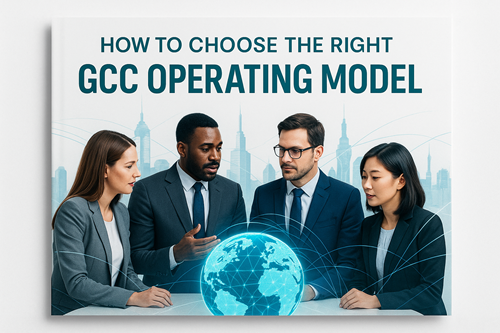
Conclusion
The GCC operating model you choose will define the role of your center in global strategy. While COCO, COPO, and BOT remain relevant, the future clearly points toward GCC 3.0, where innovation, AI, and leadership development are embedded from day one. Enterprises that view GCCs as innovation headquarters rather than back-office units will lead the next wave of global competitiveness.
What is the difference between COCO and COPO?
COCO is fully owned and operated by the parent company, giving maximum control, IP security, and compliance strength. COPO is owned by the parent but operated by a partner, offering faster entry and shared risks but lower direct control. Many companies start with COPO for agility, then move to COCO for long-term stability.
How long does a BOT transfer take?
Typically 2–4 years. Smaller setups may transition in under two years, while highly regulated industries like BFSI may require five. Some adopt BOTT, where transfer occurs only after digital and AI maturity is achieved.
Why are enterprises adopting GCC 3.0?
Because GCC 3.0 shifts focus from cost to enterprise transformation. These centers embed AI labs, nurture leadership pipelines, enable ESG compliance, and provide predictive governance. They are not just extensions of HQ, they are innovation headquarters in emerging markets.
Can companies switch models later?
Yes. Many organizations evolve their GCC model as they scale. Startups often move from COPO → COCO, enterprises may use BOT → COCO, and some blend models for different functions. Flexibility is key—GCC journeys usually involve transitions.
Stay Informed With the Latest & Most Important News
Previous Post
Next Post

Interesting Read

Tools9 months ago
GCC Setup Costs - TCO & ROI Calculator
Tools6 months ago
GCC Operating Model Selector



Tools5 months ago
GCC ESG Alignment Scorecard



GCC Specialised


Loading Next Post...