

Now Reading: Global Capability Center Cost Model: 7 Proven Levers to Cut TCO
- 01
Global Capability Center Cost Model: 7 Proven Levers to Cut TCO

Global Capability Center Cost Model: 7 Proven Levers to Cut TCO
 ScaleGCC Editorial TeamServices1 year ago846 Views
If you design your global capability center cost model only for cheap labor, you’ll get exactly that cheap outcomes. The winners model cost as a system: talent, location, cloud, governance, and incentives working together to deliver speed, quality, and innovation at a lower total cost of ownership (TCO).
What Is a Global Capability Center Cost Model?
A global capability center cost model is a structured way to forecast, track, and optimize CAPEX/OPEX for building and scaling a GCC over 3–5 years. It translates strategy into budget lines, then turns those lines into business outcomes: faster releases, higher customer NPS, and IP creation.
Core principles
Phase, don’t flood: ramp in waves; align hiring with product roadmaps.
Balance CAPEX/OPEX: seed with CAPEX only where assets last; prefer elastic OPEX in cloud.
Measure value, not activity: tie spend to release frequency, automation %, and unit cost per feature.
Know more: What is a Global Capability Center?
GCC Operating Model Selector
Try NowGCC Build-Operate-Scale Cost ROI Simulator
Try NowThe Complete Beginner’s Handbook to Global Capability Centers
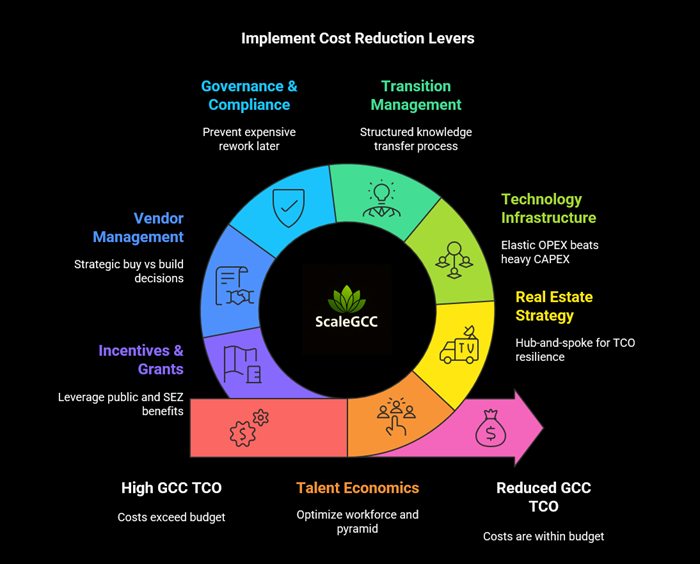
Download Now7 Proven Levers to Cut TCO
Lever 1: Talent Economics in the GCC Cost Model (Workforce & Pyramid)
Talent is 55–70% of GCC TCO. Your cost model must go beyond salaries to pyramid, mix, and productivity.
Design choices that move the needle
Pyramid & Mix: right ratio of junior:mid:senior and product:platform:ops.
EVP & Retention: proactively model attrition; each backfill can cost 50–70% of annual salary in lost velocity.
Productivity Levers: pair programming, automation, engineering enablement (CI/CD, golden paths) can deliver 10–20% unit-cost improvement by Year 2.
Interesting read: Future of GCCs Report: How AI and Talent Will Redefine Strategy
Lever 2: Real Estate & Facilities (Hub-and-Spoke for TCO Resilience)
Office costs = rent + fit-out + utilities + security + FM.
Cost-smart patterns
Hub-and-Spoke: one Tier-1 hub for leadership and deep skills; spoke(s) for scale roles.
Flexible Seats: start flex/managed offices for Year-1 ramp; convert when scale is proven.
Space per FTE: design for collaboration density, not vanity footprints.
Lever 3: Technology & Cloud Infrastructure (Elastic OPEX Beats Heavy CAPEX)
Tech lines span devices, VDI, licenses, DevSecOps toolchains, cloud, and data platforms.
Keep it elastic
Cloud-first: right-size environments; adopt autoscaling to match demand.
Toolchain Rationalization: consolidate overlapping licenses; standardize on enterprise-approved stacks.
FinOps Discipline: showback/chargeback per product to reveal true unit costs.
Lever 4: Transition & Knowledge Transfer (The Hidden Cost Curve)
Early months burn cash if knowledge transfer (KT) is ad-hoc.
Make KT predictable
Playbooks & Rehearsals: recordable demos, shadow-reverse shadow plans, and acceptance criteria.
Overlap Windows: budget for temporary dual-run to de-risk go-lives.
Stabilization Buffer: include 5–8% contingency for unplanned rework in first two quarters.
Lever 5: Governance, Compliance & Security (Prevent Expensive Rework)
Governance spend prevents costlier failures later.
Practical inclusions
RACI & Decision Rights: remove ping-pong delays; model cost of wait.
Data & Security Baselines: IAM, DLP, SOC, ISO/PCI as needed, budget upfront.
OKRs & KPI Cadence: velocity, escaped defects, cost per feature, automation rate.
Lever 6: Vendors, Tools & Managed Services (Buy vs Build)
Not everything must be in-house.
Optimize the blend
Buy for Undifferentiated Heavy Lifting: service desk, endpoint mgmt, baseline security ops.
Outcome-Based Contracts: tie partner fees to SLOs; include clear exit and IP clauses.
Tooling Tidy-Up: eliminate shelf-ware; negotiate enterprise bundles.
Lever 7: Incentives, Grants & Tax (Net TCO Matters)
Public incentives and SEZ/IT-park benefits can materially reduce net TCO.
Model it transparently
Eligibility & Tenure: reflect vesting schedules; don’t front-load savings.
Compliance Costs: include audit and reporting overhead.
Scenario Plans: conservative, base, and aspirational cases for incentives.
Common Pitfalls in a Global Capability Center Cost Model
Over-hiring seniors: Fix with a designed pyramid and career ladders.
Big-bang offices: Start flex/managed; move when utilization is stable.
Tool sprawl: Consolidate; adopt platform guardrails and golden paths.
Under-funded KT: Treat transition as a project with SLOs.
Ignoring incentives’ fine print: Model net of compliance overhead.

A global capability center cost model is not a spreadsheet, it’s a strategy. Design for capability, measure for value, and your TCO will follow.
Designing a Global Capability Center Cost Model doesn’t have to stay theoretical.
📥 Ready to Dive Deeper?
We’ve prepared a complete Capstone Project Word file with objectives, tasks, timelines, and deliverables so you can download and practice right away.
Download Project Here⚡ Learn how to build a 300-FTE GCC cost model, simulate risks, and present an executive-ready business case. Perfect for students, managers, and executives who want hands-on mastery.
A Global Capability Center cost model is a framework to calculate the Total Cost of Ownership (TCO) for running a GCC. It includes talent, real estate, technology, governance, and incentives to provide a holistic financial view.
It helps executives make data-driven decisions by balancing cost, risk, and capability. A well-built cost model avoids surprises, ensures alignment with business goals, and improves ROI.
The major cost drivers include talent expenses (60–70%), real estate (10–15%), technology/cloud (10–12%), governance, and vendor services. Incentives and productivity gains can reduce Net TCO by 5–15%.
Optimization strategies include designing the right talent pyramid, adopting hub-and-spoke city models, using cloud FinOps, automating operations, and leveraging government incentives.