
Now Reading: GCC Talent Maturity Assessment
- 01
GCC Talent Maturity Assessment

🌍 GCC Talent Maturity Assessment
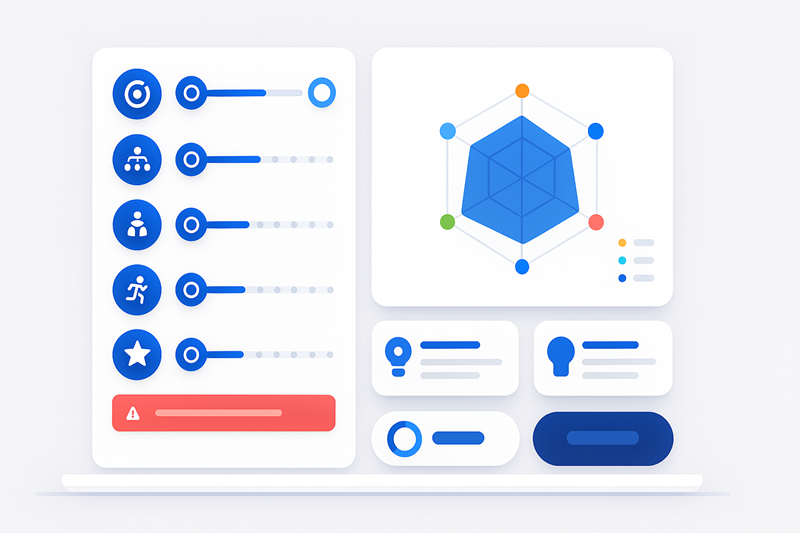
Set priority weightage (%) for each dimension and choose sub-priority scores (1–5). Click Calculate to view results.
Visualization
Targeted Recommendations
The GCC Talent Maturity Assessment helps you measure how your center performs across five priorities: Strategic Alignment, Capability Depth, Digital & AI Readiness, Workforce Agility, and Leadership. Set weights to reflect what matters most, score sub-priorities, and get a clear overall stage plus targeted recommendations you can act on right away.
How to Use
Choose weights (in %) for the five priorities so the total equals 100%.
Score each sub-priority (1–5) under every priority.
Click Calculate to generate the radar visualization and your overall maturity stage.
Review the two weakest weighted contributors and follow the suggested actions.
Reassess quarterly (or after major changes) to track progress.
Trending Scorecard and Assessment Tools
What is GCC Talent Maturity and why does it matter?
It’s a framework that gauges how effectively a Global Capability Center attracts, develops, deploys, and governs talent. Higher maturity correlates with stronger strategic impact, faster innovation, lower risk, and better cost-to-value.
How do I assess whether my GCC has reached advanced talent maturity?
Assessments typically use frameworks covering skills, leadership, culture, digital adoption, and workforce scalability. Advanced maturity shows in strong retention, robust leadership pipelines, and agility in adopting new technologies.
How does talent maturity impact innovation capacity in GCCs?
A talent-mature GCC fosters innovation because employees are upskilled, leaders are empowered, and teams can adopt emerging technologies quickly. Talent maturity directly drives innovation outcomes.
What benchmarks should a scaling GCC target in its first 3 years?
By year 3, GCCs should target stable retention rates, at least 30–40% talent upskilling, a strong local leadership layer, and adoption of AI/automation-driven processes.
How can GCCs assess talent maturity before digital transformation or AI adoption?
HR and leadership teams should run structured maturity assessments that measure digital readiness, technical skill availability, and learning culture before investing in AI or cloud transformation.
What does high attrition signal about a GCC’s talent maturity level?
High attrition often signals immature talent practices,lack of career progression, poor engagement, or insufficient upskilling. Mature GCCs usually maintain attrition below industry benchmarks.
How can enterprises compare talent maturity across global GCC locations?
Comparisons should include parameters like leadership depth, learning culture, skill availability, and employee engagement. Regional talent ecosystems also influence maturity levels.
Disclaimer
These tools are meant to provide quick, general insights, not exhaustive advice. They should not replace professional consultation or in-depth analysis. Users are encouraged to verify information and seek expert guidance before making decisions.
Contact Expert